
Bioprinting, the fusion of 3D printing and biology, has the potential to transform tissue engineering as we know it. However, traditional 3D printers are not well-suited for the manyfold requirements of bioprinting, according to Aleksandr Ovsianikov, head of the 3D Printing and Biofabrication Research Group at the Technical University of Vienna. In a recent interview with chemiereport.at, Austrias magazine for Economics, Technology and Research, Aleksandr provides on overview of his team’s groundbreaking research and prospects in the field.
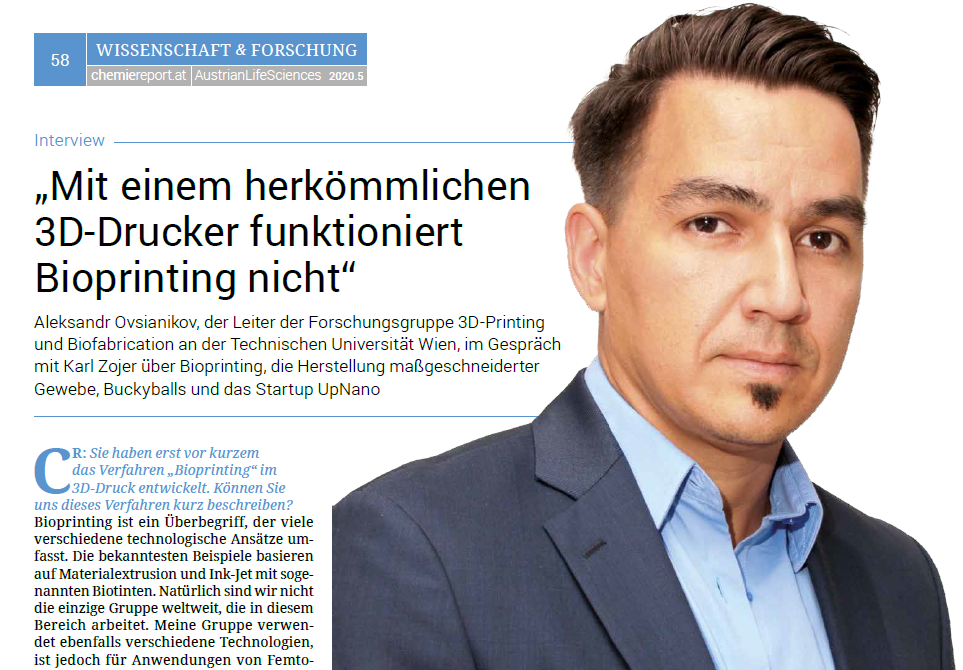
Bioprinting encompasses various technological approaches, with material extrusion and inkjet methods being prominent examples. Researchers worldwide are actively working in this field. Aleksandr’s team is recognised for its use of femtosecond lasers in high-resolution 3D printing, a technique known as multiphoton lithography. This cutting-edge approach allows for the creation of intricate structures, even on a microscopic scale.
However, diving into bioprinting requires careful consideration and adaptation. Using only a conventional 3D printer is unlikely to yield successful results. Optimising bioprinting processes can be challenging, as different cell types may require specific materials and exhibit varying sensitivities. Therefore, Aleksandr’s team is engaged in a project supported by the EC Consolidator Grant, focusing on generating patient-specific bone and cartilage tissue.
A fascinating aspect of bioprinting is the concept of “buckyballs,” created by Aleksandr’s team, which refers to 3D microstructures resembling Buckminsterfullerene molecules on a larger scale. Developed in collaboration with bioprinting pioneer Vladimir Mironov, these microstructures represent a new strategy in tissue engineering. Their porous structure, approximately 300 micrometers in diameter, acts as protective scaffolds akin to roll cages in racing cars. The resolution necessary for such complex structures is achieved through two-photon polymerisation, a technique mastered by Aleksandr’s team.
Collaboration is crucial for advancing bioprinting research. Aleksandr’s team actively collaborates with Ludwig Boltzmann Institute for Traumatology as well as partners from Belgium and the Viennese startup UpNano, a system provider for 3D-printing and partner of the Cluster. These collaborations underscore the interdisciplinary nature of bioprinting, creating optimal conditions for further advances in 3D-printing in Austria.